…We are halfway through our New year Challenge and 91 members are still in the race to complete their 24 sessions and, of course, their second (and hopefully a third) body assessment…I really can’t explain why, but after 6 years of hosting Fitness Challenges I still experience times that I hold myself personally responsible for everyone`s weight loss success.
I know it’s silly – I don’t go home with everyone every day, I don’t follow them around knocking unhealthy food out of their hands, I don’t know their private food choices, habits and indulgences – but what I DO get, very often, is this question: “Mirna, why can’t I lose weight?” And it breaks my heart every time I hear it…
See, at our studio we don’t offer diets or meal plans, but we do share our experience and offer advice, although we`re not nutritionists or dietitians. And this weekend, I have thought of a way to shed some light on why the “eat less and move more” theory sounds nice in theory, but is in fact insulting to those who know this, try their best, and still not succeed.
I`m going to keep things simple…let`s start with an oversimplified look at weight loss: 1 kilogram of body fat contains the equivalent of 37,000kJ. So, to lose weight, you need to create a deficit of 37,000kJ. (Sounds daunting already, I know). This would mean you’ll need to eat either 37 000 less kilojoules or burn an extra 37 000….Ouch.
Uhm, so how long does it take to burn 37 000 additional kilojoules…How many hours do you have?! Simply put, exercising your way thin has been proven time and again not to work, because you can’t outrun your fork…And the bad news isn’t done…
When you start to lose weight, there is less of you that needs “fuel”, which means that unless you adjust your calorie intake as your weight decreases, you will hit a plateau where calories burned equals calories consumed…And then it gets even worse!
There are buckets of evidence of a bodily feature called “adaptive thermogenesis”. This refers to the process in which our bodies will adjust based on how many calories we burn – and do whatever it can to preserve the body fat we have. Yip, our bodies want to maintain the extra body fat we have (“I don`t know when I`ll need this, better save) – that`s simply why it`s such a persistent challenge to keep the weight off. And that`s why so many people can lose weight, but can`t seem to keep the weight off.
This is also not even factoring in all the other issues around our bodies – psychological challenges, menopause, depression, hormones, anxiety, etc. etc. All these things cause our bodies to crave food, to try and store food and make it tough for us to keep our calorie intake under control.
…But why am I keeping you busy with all this terrible, horrible, no good, very bad news?
Because MANY, MANY people HAVE lost weight, and kept it off. People who are older, bigger, have more children, less money, more illnesses and bigger hardships than you. Yes, it IS a constant battle, but one that`s absolutely worth fighting. Sure, we are all flawed. But we`re not doomed!
What then, is the simple explanation why we can`t lose weight? Consuming more energy than our bodies need. If weight loss is your goal, you need to consume fewer calories than you burn on a consistent basis. End of story. By doing so, your body has no choice but to dip into that saved fund of fat stores to still get all of its body tasks done. Do this consistently, and that`s how you end up with a lower number on the scale and a smaller pants size.
And it starts here: We need to eat fewer calories, but it also has to be sustainable and enjoyable otherwise we`ll never stick with it…The problem is, just saying “eat less” doesn’t factor the crazy biological, physiological and emotional challenges we face every day. We might eat when were stressed, depressed or bored. We might be on medication that is causing us to overeat without even realising it. We can`t eat just one potato chip without eating an entire bag…And, not only that, even when we pay attention to what we eat, studies show that we often underestimate our calorie consumption by 30% plus!
Crap. This keeps getting worse…
What are we supposed to do????
If weight loss is your goal, you need to shift your food choices to foods that give you more “bang for your buck” – healthy, filling, nutritious foods – protein, veggies, fruit and healthy fats – that fill you up and makes you less likely to overeat calorie-bomb foods…I know it sounds like a cliché, but if you can start to make even small changes, substituting nutrient dense foods for junk food – it`s going to shift the energy balance back in the right direction.
But first get your mind in the game. Losing weight IS hard. Being overweight IS hard. Choose your hard…
And then? Stop trying to find quick fix solutions and put all your focus on slowly adjusting your eating habits. Be deliberate in your decisions, because every calorie counts.
…During our body assessments, I try to stress the importance of portion control, but if still in doubt, here are a few eye-opening facts that might help:
Not sure how many calories your body needs? The Mifflin-St Jeor equation is a good starting point to calculate your daily calorie intake…
Then, when thinking smaller portions and building a plate of food, aim for the following amount of protein:
Dudes: 170-228 g (2 palms)
“Dudettes”: 85-114g (1 palm)
Half of your plate should be veggies! (Plus minus a cup size). These veggies can eventually be the difference between success and failure:
Broccoli, Cauliflower, Spinach, Kale, Spaghetti squash, Brussels sprouts, Zucchini, Cucumber, Carrots, Onion, Asparagus.
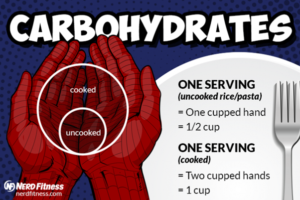
Here are some examples of healthy carbs: Fruit, brown rice or Basmati, legumes, lentils, Sweat potato, whole grain pasta or bread.
And here’s the serving size:
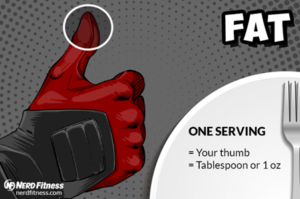
Healthy fats can be found in foods like: Avocado, almonds, walnuts, Macadamia nuts, Olive oil, Almond butter, Peanut butter. And this is the serving size!
Saturated fats – consumed in moderate quantities – can come from things like: Milk, full fat diary, coconut oil, grass-fed butter, fatty cuts of meat.
Drinking enough water is not a health myth, but an important tool in lowering visceral fat, enhancing weight loss and suppressing appetite.
..Yes, it would be awesome if you could swallow a magical pill, wrap yourself in plastic or attach yourself to electrodes to reverse the past decade of damage you’ve done to your body.
It would also be cool if superheroes were real and I could fly…☺
If you have found this piece of writing utterly boring, please don’t bother to read any further…If not, bear with me a little longer…
You see, I`m not really clued up with diets, as my own BMI is constantly on the verge of being underweight. (That`s just me being genetically lucky). But, my clients’ well-being is a top priority, so I try to stay informed about most of the popular diets:
- Paleo – cutting out grains and diary, consuming only meat, veggies, fruits and nuts
- Keto – cutting out all carbs, consuming only meat, veggies, nuts and fats
- Intermittent fasting – cutting out an entire meal every day
- Carnivore diet – Only eat meat, remove everything else
- And of course the famous 28 day diet, cutting out sugar, wheat, diary
And all of them work, because they make you consume fewer calories on average than you normally eat. The question is, can you stick to this way of eating for life? For what sense is their in sticking religiously to a diet thinking that in 30 days you can go back to your old habits again?
I think, if we humans can simply come to the understanding that we:
Underestimate how much we eat, and
Overestimate how much we burn,
Then we`re already on the the right track.
I’m not informed enough about the FitnessPal App of tracking calories, but I have witnessed how my own daughter has dropped her body fat percentage drastically over the last few months by simply staying in a calorie deficit, in other words burning more calories than what she eats.
If I could write a book about calorie deficit for dummies I would say:
You don’t even need to calculate your:
- Basal metabolic Rate (BMR)
- Total daily energy expenditure (TDEE)
These are nice to knows, not need to knows.
Fact is – you cannot lose weight if you are not in a calorie deficit. Not losing by cutting portion sizes, then you should decide if it`s worth the trouble to dig a little deeper. All depends on how important it is to you…
How to create a calorie deficit the easy way?
- Find out exactly where you are at, so you can make plans where you are going.
- Do yourself the favour and spend 7 days tracking your food intake with an App like MyFitnessPal, it`s very user friendly.
- Weigh yourself every day for 7 days.
By the end of the week you`ll be able to track two figures – your body weight and your average calorie intake. (Remember, one calorie is 4,18 kilojoules).
If your weight does not go down over time, then you`re still eating too much. The proof is in the pudding…☺, or the loaded plate before you on the dinner table…☺
…If you`re sick and tired of the scale not budging, you should stop and think twice about all your snaccidents – (noun) eating too much by mistake… Allow yourself to be human and have bad days, and never say never. Your body needs, protein, carbs and fats, all in moderation. You don’t have to be a saint with your food, but you can’t eat like every day is thanksgiving either.
All jokes aside, as Karen Salmensohn says: “Studies show that NOW is the best time for you to start that healthier diet.” If other people can do it, you can do it. Stop listening to your inner fatty – she’s an evil witch who misses cupcakes all the time. You are really stronger than you think…
In the words of famous author, Nikki Rogers: “Strength does not come from what you can do. It comes from overcoming the things you once thought you couldn’t”.
Decide. Commit. And you`ll see. You WILL succeed.
Yours in fitness
Mirna
082 779 0507